
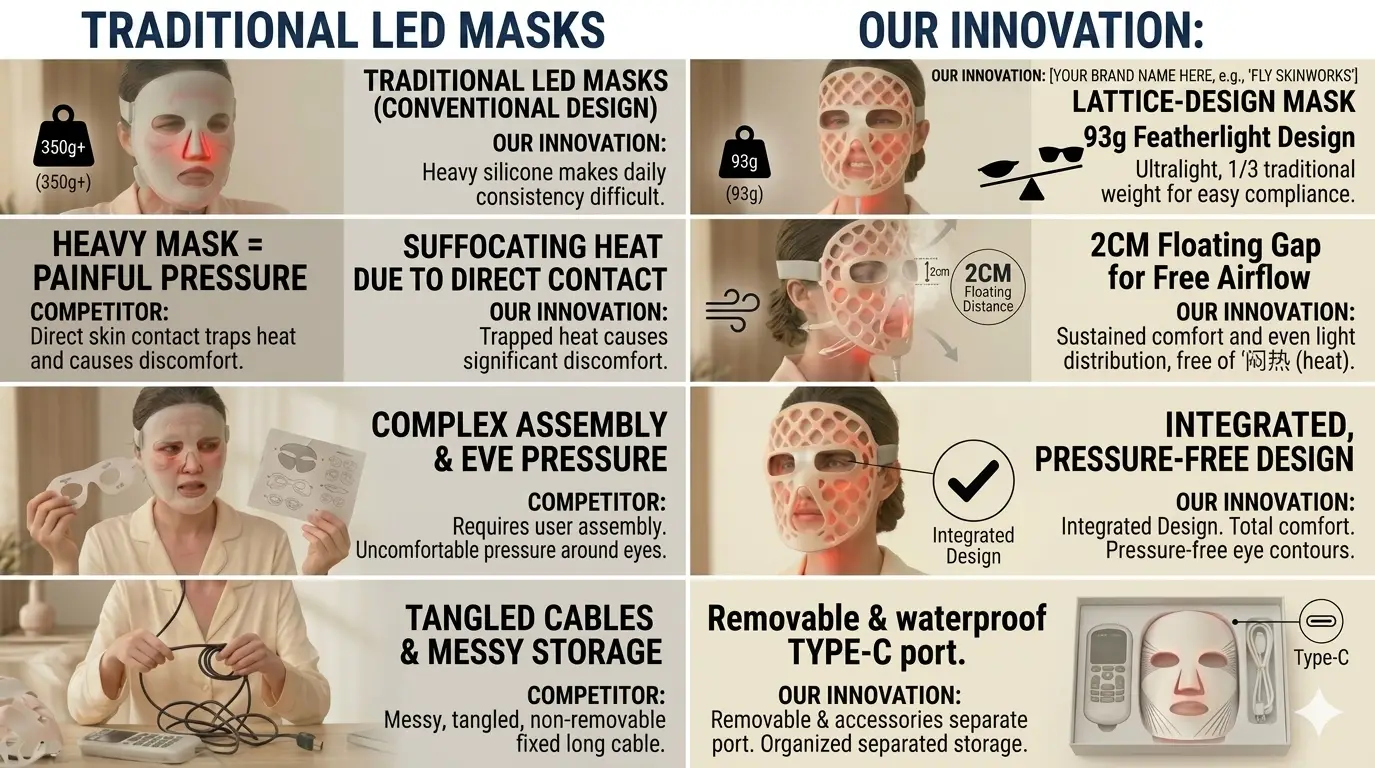
If your team is choosing between private label, OEM, and ODM for an LED face mask launch, the short answer is this: private label is usually the cleaner first step for brand teams launching on an existing product base, OEM makes more sense when your requirements are already more defined, and ODM is often better treated as a later-stage path rather than the default starting point.
That distinction matters before quote stage. If you compare suppliers before you know which project model fits your launch, you usually compare the wrong things.
Which path usually fits which launch stage?
For most skincare brand launches, the decision is less about which term sounds more advanced and more about which conversation your team actually needs first.
- Private label usually fits teams launching under their own brand on top of an existing product base.
- OEM usually fits teams entering the conversation with clearer product requirements or a more defined execution scope.
- ODM usually points to a heavier development path or a larger supplier role in shaping the product direction.
If your team is still validating launch fit, branding scope, and sample workflow, private label is often the simpler place to start.
Why this decision should happen before supplier comparison
Many supplier pages place private label, OEM, and ODM next to each other as if they are interchangeable. They are not.
The project model changes what your team should be evaluating:
- how much of the product base is already defined
- whether the discussion is mainly about branding or product execution
- what should be clarified before sample stage
- how useful any quote comparison will actually be
This is why the model decision should happen before a supplier shortlist gets too far. If the model stays vague, branding scope, sample path, and next-step expectations all become harder to compare.
When private label is usually the cleaner first step
Private label is usually the best starting point when your brand wants to launch faster on top of an existing product base instead of beginning with deeper product development.
In practice, that conversation is often centered on:
- brand presentation
- packaging and insert scope
- what can be customized without reopening the product base
- how the sample and approval path should work
For first launches, this is often the clearest route because it helps the team focus on launch readiness instead of forcing a deeper development discussion too early.
Private label is not the same as unlimited customization. Its value is clarity. The supplier should be able to separate what stays standard from what can be branded for launch.
After you choose the model, what should you still check in the product base?
Once your team has chosen the launch path, there is still a second filter to apply: will the underlying product base be easy to explain, sample, package, and support after launch?
In practice, stronger product bases usually reduce the friction that makes LED masks harder to position:
- a cleaner integrated structure instead of a fiddly assembled feel
- comfort and wearability that are easier for buyers to understand
- simpler eye-area, storage, and home-use logic
- packaging and insert flow that supports a clearer brand presentation
- an overall product story that feels easier to explain after sample stage
This is not the main model-decision criterion. It is a secondary filter. Even if private label is the right route, the base product still needs to be easy for your team to position and support.
When OEM is the better fit
OEM usually becomes the better fit when your team already knows more specifically what must be controlled, changed, or executed for the product.
That means the discussion is no longer only about brand presentation. It is more likely to involve a stronger execution brief from the buyer side.
OEM is usually more suitable when:
- your team already has a tighter product requirement
- the standard product path is not enough
- the execution scope needs to be discussed more precisely before sample stage
If your team enters with a clearer product brief, OEM can make supplier comparison cleaner because the conversation is built around a more defined requirement set.
When ODM adds complexity too early
ODM can be relevant when the supplier is expected to play a larger role in the product path or development direction. That can be appropriate in some situations, but it is often the wrong default for an early brand launch.
Why? Because many first launches still need to answer simpler questions first:
- Is the product direction right for our market?
- Do we need branding clarity before deeper development?
- Can we validate fit before adding more complexity?
If those questions are still open, ODM often introduces too much scope too early. It can make the sourcing conversation feel more advanced while actually making the decision harder.
Quick comparison table
| Model | Best starting point when | Main discussion focus | Usually less suitable when |
|---|---|---|---|
| Private label | you want to launch under your own brand on an existing product base | branding scope, packaging, sample path, launch readiness | you already need a more defined product execution path |
| OEM | you already have clearer product requirements or execution expectations | product requirement clarity, execution scope, controlled changes | your team is still deciding the basic launch path |
| ODM | you need a deeper supplier role in product direction or development path | broader development discussion and model direction | you still need to validate fit, branding scope, and launch basics first |
Launch-path checklist before you ask for quotes
Use these questions before you start comparing suppliers:
1. Are we launching on an existing product base or asking for a more defined execution path?
If the answer is existing product base, private label is usually the clearer starting point.
2. Are we mainly solving for launch readiness or deeper product requirements?
If the main issue is launch readiness, private label usually keeps the conversation cleaner. If the issue is more detailed execution scope, OEM may fit better.
3. Are we trying to validate the category first or enter a heavier development path now?
If validation is still the priority, ODM may be early.
4. Can the supplier clearly explain what stays standard and what changes with scope?
If the answer is no, the conversation is still too vague regardless of which label is being used.
5. Does our quote request reflect the actual model we need?
If your inquiry does not reflect the real project path, quote comparisons will become noisy fast.
FAQ
What is the difference between private label and OEM for an LED face mask?
Private label usually starts from an existing product base and focuses more on branding and launch readiness. OEM usually fits buyers who already have clearer product requirements or a more defined execution scope.
Which path is usually better for a first skincare brand launch?
For many first launches, private label is the cleaner starting point because it keeps the conversation focused on launch fit, branding scope, and sample workflow before deeper complexity is added.
Is ODM the best choice for an early launch?
Not usually. ODM can make sense later, but it often adds complexity before the team has clarified launch basics such as market fit, product direction, and scope boundaries.
Why should this decision happen before quote stage?
Because the wrong model choice makes supplier comparison harder. If the project path is unclear, pricing, sample expectations, and customization discussions all become less useful.
If your team is still deciding whether private label, OEM, or ODM is the right route for your LED face mask launch, start the conversation through /contact/ with your target market, brand stage, and the scope you want to clarify before sample stage.
Discuss Your LED Mask Launch Path
Wholesale & product resources
For factory-direct pricing and OEM options, see our LED mask wholesale page. Compare the 93g MMZ01 flagship, 85g MBZ01 neck mask, and full product catalog.
Radiant GEO Cluster
Connect launch path decisions to sourcing and compliance
After choosing private label, OEM, or ODM, compare factory proof, MOQ planning, documents, and product platforms before deposit.
- OEM / wholesale sourcing
- Certifications & compliance hub
- Import document checklist
- LED light therapy guide
- Private-label CE certificate guide
- MMZ01 LED facial mask
- LED neck mask
- How to choose a wholesale supplier
- China sourcing checklist
- Private label MOQ guide
- 2026 LED face mask market map
- Real factory verification guide
- Radiant vs flat LED masks
- Import document checklist template
- Supplier evaluation checklist
